
Volume slows, value holds: the residential market in October 2026
By Vantys Group — The value behind every wall
The Spanish property market has reached a curious point: demand is still there, but fewer and fewer households can afford it. Prices remain at record highs, sales have fallen for the seventh month in a row and the Euribor is rising again. On top of that, October has begun with a regulatory vacuum and a general election called for the end of November.
Every month, Vantys Group analyses the data that really matters to anyone looking to buy, sell or invest on the Costa del Sol. Here is what the market is telling us in October 2026.
An affordability ceiling before a demand ceiling
After easing in late 2025, the 12-month Euribor has risen again, standing at 3.30% in early October, its highest level since August 2024. September inflation (CPI) jumped to +4.9%, the highest figure since February 2023.
Globally, the OECD and UBS estimate that a skilled worker has lost a third of their property purchasing power compared with 2021. The picture in Spain is similar: prices keep climbing, but sales, mortgages and households’ ability to borrow are starting to contract. The market appears to be hitting its affordability limit before its demand limit.
July’s figures
According to Spain’s General Council of Notaries:
- Average price: €2,110/m² (+7.7% year-on-year)
- Apartments: €2,550/m², a new all-time high (+12.5%)
- Transactions: -11.1% year-on-year, the seventh consecutive drop (65,400 homes)
- Andalusia, the region with the most sales in Spain: 12,800 in July, 20% of the national total
- 56% of purchases were financed with a mortgage, with an average loan of €183,600
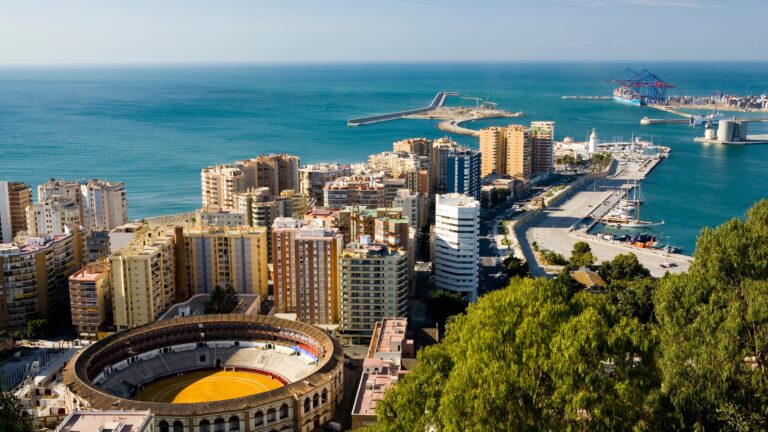
Málaga breaks the €3,000/m² barrier
The regional average hides very different realities. According to the appraised value published by the Ministry of Housing, the benchmark used by banks, Málaga has exceeded €3,000/m² for the first time: €3,083.5, up 13.8% on a year ago. It is the most expensive province in Andalusia and costs 3.4 times more than Jaén.
Some facts that confirm what we see every day in our work:
- Marbella is the second most exclusive location in Europe for a luxury seafront home, according to Engel & Völkers. Only Saint-Jean-Cap-Ferrat ranks higher, with Marbella ahead of Saint-Tropez, Mallorca and Ibiza
- Ilanga Capital and Goldman Sachs will invest €260 million in Marbella in a hotel complex with branded residences
- Foreign buyers accounted for 15% of purchases in Andalusia in the first half of the year (10,280 homes). In Málaga, one in four people looking to rent is searching from abroad
- Andalusia will cut property transfer tax (ITP) from 7% to 6.75% in 2027, with the aim of reaching 6% by 2030
The legislative vacuum
September was a turning point. Following a wave of housing protests, the Government approved two emergency decree-laws. They included suspending evictions of vulnerable tenants until 2030, automatic extension of rental contracts, regulation of temporary and room rentals, and 10% VAT on holiday lets. Parliament rejected both decrees on 2 October, and the Government has called a general election for the end of November.
Meanwhile, the Partido Popular (PP) has put forward its alternative: one million homes in four years, the removal of designated rent-stressed areas, public guarantees for young buyers and tax cuts on purchases. In the meantime, owners and investors face two months of regulatory uncertainty.
2027: lasting pressure, not a correction
BBVA Research forecasts price growth of +5.7% in 2027, roughly half this year’s rate. The underlying problem remains the same: Spain brings around 95,000 new homes to market each year, while some 240,000 new households are formed. The Bank of Spain puts the housing shortfall at around 750,000 homes and warns it could exceed one million by 2028.
Energy efficiency is also weighing more and more on price. Homes rated A or B sell on average for 15% more and twice as fast. Yet 94% of Spain’s housing stock has an energy certificate between D and G.
The Vantys view
The headlines talk about a market that is slowing down. The reality is more nuanced: volume is slowing, value is not. On the Costa del Sol, Málaga has crossed €3,000/m², Marbella is measured against the Côte d’Azur and international capital keeps arriving. At the same time, local buyers feel every rise in the Euribor.
For sellers, the message is clear. Prices remain well supported, but solvent buyers are more selective and no longer pay any figure asked. A well-valued, well-presented home sells; an overpriced one stays on the portal. For rental investors, the regulatory vacuum until the election calls for caution and well-structured contracts.
Our job at Vantys Group is not to repeat the headline. It is to translate it into what it means for your specific decision, on your street and at your moment. That is what lies behind every wall we analyse.
Download the Vantys Residential Market Report
If you would like to dig deeper into the data, you can read our Residential Market Report – October 2026, covering price and transaction trends, the specific situation in Málaga, the regulatory context and the outlook for 2027.
If you are weighing up your next property move on the Costa del Sol, let’s talk: knowing the ground makes all the difference.
📞 +34 687 948 012 · ✉️ info@vantys.es · www.vantys.es
Report prepared with data available as of October 2026. Sources: General Council of Notaries, Ministry of Housing and Urban Agenda, Bank of Spain, BBVA Research, Property Registry, UBS, OECD, INE (National Statistics Institute), Engel & Völkers.